Hey folks, let’s cut to the chase – if you’re running a workshop, a manufacturing facility, or any industrial setup that deals with moisture in compressed air, you’ve probably got a refrigerated air dryer hooked up. But if your work environment’s not exactly “clean and dry” – like, say, a food processing plant with high humidity and occasional caustic washes, a chemical plant, or a marine facility where salt air’s a constant headache – you’ve definitely wondered: can my standard refrigerated air dryer even survive here? Or am I just gonna drop cash on a unit that rusts out or corrodes in 6 months? Refrigerated Air Dryer
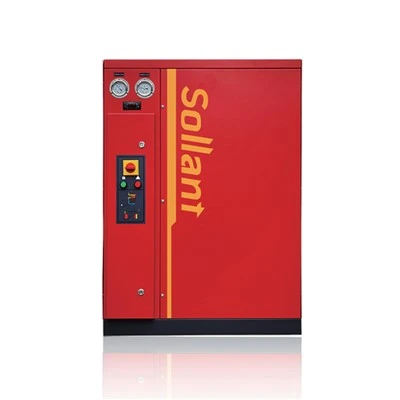
As someone who’s been selling refrigerated air dryers for over a decade now, I’ve heard this question a hundred times, and the short answer is: it’s not a straight “yes” or “no.” It depends on what your “corrosive environment” actually is, and how you build (or spec) your dryer to handle it. Let’s break this down without the jargon, promise.
First, let’s make sure we’re talking about the right corrosive environments here. Because not all corrosion’s created equal. I see clients mix this up all the time. Like, a meat processing plant that sprays food-safe sanitizers? That’s mild corrosion – maybe a little moisture with low-grade acid, nothing crazy. But a shipyard where salt air’s blowing nonstop, or a battery manufacturing plant with fumes from heavy metals, or a fertilizer plant that’s full of ammonia and sulfur? That’s heavy, aggressive corrosion – that’ll eat through regular steel faster than a kid’s sneakers on a playground.
Standard off-the-shelf refrigerated air dryers – yeah, the ones you see on every industrial supply shelf – are usually built with plain carbon steel for their air vessels, maybe a cheap powder coat that chips off after a year or two. Stick one of those in a marine yard, and your dryer’s gonna start showing rust spots on the outer casing within 3 months, and the internal air vessel? By year 2, that’ll have pits so deep, moisture’s gonna start seeping through anyway, defeating the whole point of a dryer. So for heavy corrosion, standard units are a hard pass.
But here’s the thing I wish more clients knew: you don’t have to throw out a refrigerated air dryer entirely to handle corrosive environments. You just need to spec it right. Let’s walk through the key parts that get corroded, and what fixes work.
First, the air vessel. That’s the big tank that holds your compressed air before it hits the cooling loop, right? Standard ones are carbon steel, which reacts with moisture and acid fumes super easily. For corrosive setups, you’ve basically got two options: either use a material that doesn’t corrode, or coat the steel so well nothing can get through. Stainless steel is the go-to for most aggressive environments – 304 or 316 grade, depending on how harsh your fumes are. 316’s better for salt or heavy chemicals, just a tiny bit pricier, but way cheaper than replacing a ruined dryer. If you’re on a tighter budget but still dealing with mild to moderate corrosion, there’s a thing called a fusion-bonded epoxy (FBE) lining for carbon steel vessels. That’s not the cheap powder coat – it’s a full lining that’s baked on, so it doesn’t chip as easy, and it keeps corrosive agents from touching the steel inside. I’ve had clients use FBE lined dryers in coastal breweries for 7 years now, no rust issues.
Next up, the heat exchange core. That’s the part where the compressed air gets cooled down to condense moisture – super important, because if that core corrodes, it can leak air, or get clogged with corrosion debris, making your whole dryer useless. Standard cores are aluminum, which actually does pretty well on its own, but if your environment has salt or sulfur fumes, aluminum can get pitted too. The fix here? Either a copper-nickel alloy core (that’s what shipboard dryers use) or a coated aluminum core. The coating’s usually a thin acrylic or epoxy layer that seals the aluminum, so no corrosive particles can grab onto it. I sold a set of those coated core dryers to a seafood processing plant last year, and their maintenance guy told me they’re still running strong, way less issues than their old aluminum core unit that died in 18 months.
Then there’s the outer casing and electronics. A lot of people sleep on the electronics – the control panels, sensors, pressure switches – but corrosive fumes can eat through circuit boards faster than you think. Standard control panels are just plastic, which is fine for clean environments, but for corrosive areas, you need them sealed in NEMA 4X enclosures. That means they’re watertight, dust-tight, and sealed tight enough that fumes can’t get in. Also, for the casing itself, instead of cheap powder coat, go for a polyester powder coat with a zinc primer under it – that’s way more corrosion resistant. I saw a client test a zinc-primer-coated vs. a regular powder coat unit in a salt spray chamber (super harsh test) – the regular one had rust through in 120 hours, the zinc one held for 500 hours. No contest there.
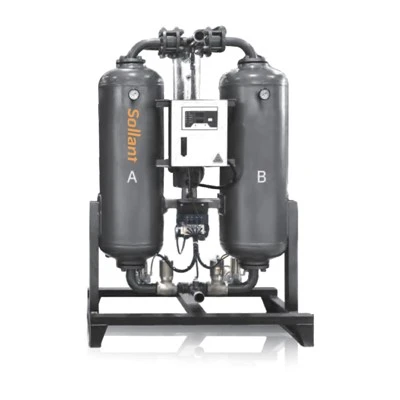
Wait, but let’s be clear: there are environments where even the best spec’d refrigerated air dryer isn’t a good fit. Like, if you’re in a place with constant exposure to hydrofluoric acid or strong chlorine (like a water treatment plant that uses bleaches at full blast), refrigerated dryers might not hold up – you’d be better off with a desiccant dryer for that. But for 90% of the corrosive environments I see – food processing, marine, chemical manufacturing, agricultural fertilizer facilities, even auto body shops that use acid-based paint cleaners – a refrigerated dryer can work, as long as you spec the right materials.
I get why some people are skeptical. A couple years back, I had a client who ran a metal plating shop – that’s super corrosive, with nickel and chromium fumes. He bought a standard refrigerated dryer because it was cheap, and within 8 months, the air vessel had corroded through, leaking all over his workshop. He came back to me, and we swapped it for a 316 stainless steel vessel dryer, with a coated core and NEMA 4X enclosure. That unit’s been running for 3 years now, no issues. He told me it cost 20% more upfront, but he saved way more on replacement costs and downtime. That’s the other thing a lot of clients miss: upfront cost vs. total cost of ownership. A cheap unit that dies in a year is way more expensive than a good spec’d one that lasts 10.
Also, don’t sleep on installation and maintenance when you’re dealing with corrosion. Like, even the best spec’d dryer will fail if you install it where salt spray can pool on the casing, or if you skip regular checks for chipped coatings. I always tell clients: in corrosive environments, do a visual check every 3 months – look for rust spots, peeling coatings, or any signs of corrosion on fittings. And when you do maintenance, use corrosion-resistant tools, and wipe down the exterior regularly to keep fumes or salt from building up. It’s a tiny step that adds years to your dryer’s life.
Let me throw in a quick example of a real project I did last year, to make this concrete. A client in the Gulf Coast – coastal Louisiana, so salt air’s brutal, plus they run a catfish processing plant, so they’re washing with high-pressure water and food-grade sanitizers. They came to me with a 5-year-old refrigerated dryer that was already rusting, and their compressed air had 2x more moisture than it should. We worked with them to spec a unit with: 1) FBE-lined carbon steel vessel (cheaper than stainless, enough for their mild-moderate corrosion), 2) coated aluminum heat core, 3) NEMA 4X control panel, 4) zinc primer + polyester coated outer casing. We also mounted it on a raised frame so it wasn’t sitting on the ground where water pooled. That unit’s been up for 10 months, and their maintenance manager texts me every month saying it’s running better than their old unit ever did, and no rust so far.
So to circle back to the original question: Can a refrigerated air dryer be used in a corrosive environment? Yes, absolutely – but only if you skip the off-the-shelf, cheap one, and spec it for the corrosion level you’re dealing with. If you’ve got mild corrosion (like food processing, low industrial), FBE lining and coated cores will work. If it’s heavy (marine, heavy chemicals), go with 316 stainless steel parts and NEMA 4X enclosures. If it’s super aggressive, you might need a different dryer, but that’s a small minority of cases.
I know a lot of suppliers will just tell you “our standard dryers work everywhere” or “corrosive environments kill all refrigerated dryers” – but that’s the nonsense that makes clients waste money. The real answer is it’s all about the specs. If you’re not sure what you need – if you’re trying to figure out how to spec a dryer for your facility, or you’re tired of replacing units that rust out in your corrosive space – hit us up. We can walk through your environment, your compressed air needs, and find a dryer that’ll last, not just last for 6 months.
Don’t get stuck with a dryer that dies because you didn’t account for corrosion. Let’s work out the right solution for you.
Desiccant Air Dryer References
- Compressed Air Air Dryers: Selection and Application, Compressed Air and Gas Institute, 2021
- Corrosion Resistance of Refrigerated Air Dryer Materials, Industrial Maintenance & Plant Operation, 2022
- NEMA Enclosure Types for Corrosive Industrial Environments, National Electrical Manufacturers Association, 2020
- Fusion-Bonded Epoxy Linings for Compressed Air Vessels, American Welding Society, 2019
Shanghai Sollant Energy Saving Technology Co., Ltd.
As one of the most professional refrigerated air dryer manufacturers and suppliers in China, we’re featured by quality products and good service. We warmly welcome you to buy bulk advanced refrigerated air dryer from our factory. If you have any enquiry about cooperation, please feel free to email us.
Address: No.215, Songri Center, Beihongqiao, Jiading District, Shanghai, China
E-mail: info4@sollant.com
WebSite: https://www.sollanttreatment.com/
